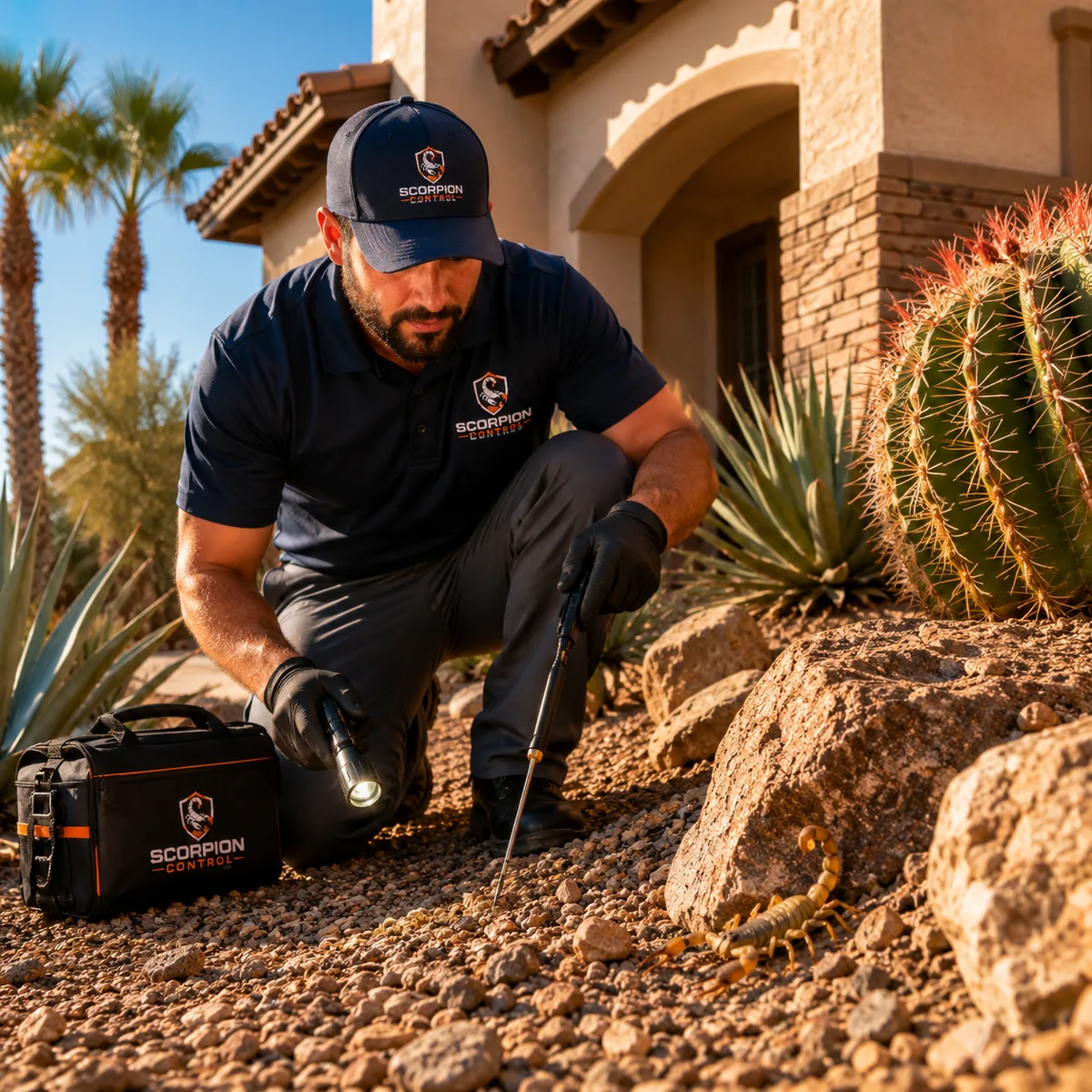
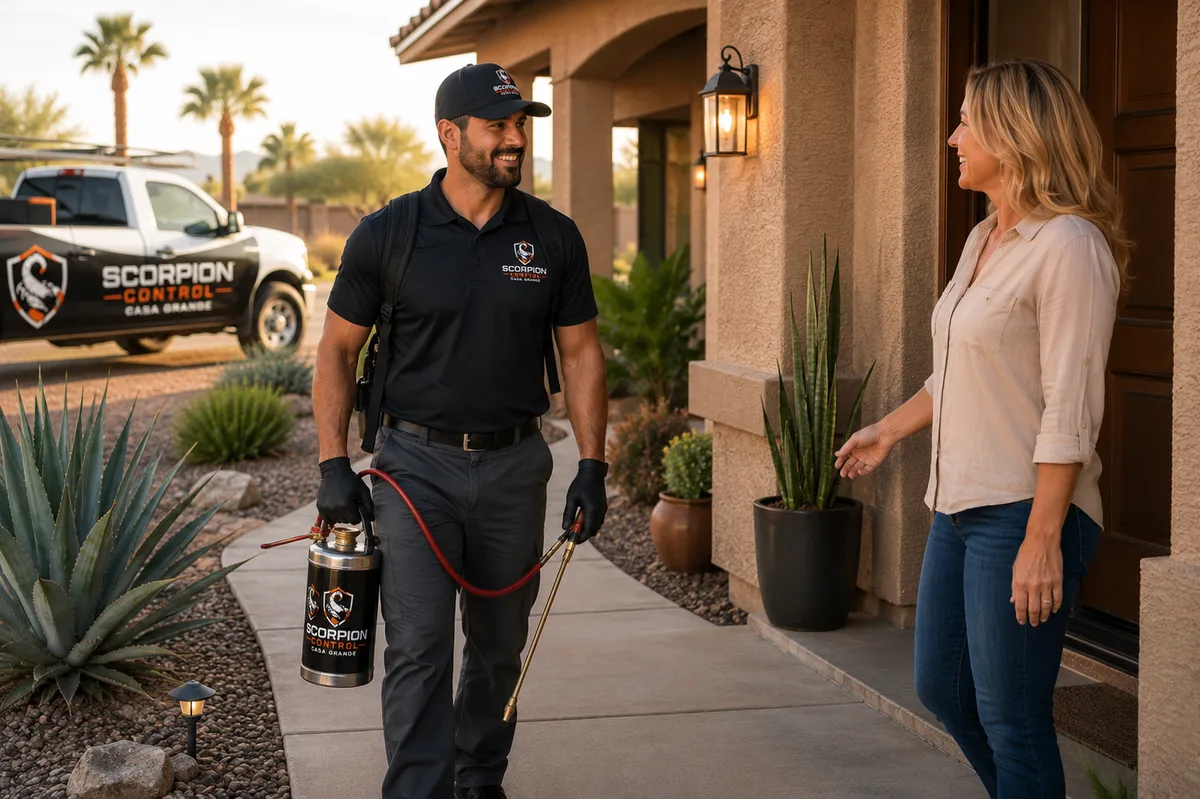
We seal scorpions out, we don't just spray and leave. Scorpion Control Casa Grande is a local, exclusion-led service for homeowners across Casa Grande and Pinal County. No crews driving down I-10 from Phoenix and no franchise script, just techs who know how bark scorpions get into the homes built right here.
Getting rid of scorpions in Casa Grande takes two things working together: sealing the entry points they use to get inside your home, and reducing the insects they come indoors to hunt. Spraying alone rarely works for long, because bark scorpions can survive months without food and simply wait out a single treatment.
Lasting control means finding the specific gaps on your house — especially the weep screed where stucco meets the foundation — sealing them, and keeping a treated barrier active on a schedule. Start with a free inspection to find where they're getting in.
Get a Free Inspection
Arizona stucco construction — bark scorpions enter through gaps thinner than a credit card, particularly at the weep screed line.
Counter to what most people expect, the open Sonoran Desert around Casa Grande holds relatively few scorpions. The raw desert is too dry and too short on prey to support large numbers. Homes change that. The water and landscaping we add create exactly the conditions scorpions and their food need to thrive.
Out in undeveloped desert, scarce water keeps insect populations low, and scorpions can only live where their prey lives. The bark scorpion's diet is mostly crickets, roaches, and other soft-bodied insects — and those insects need moisture. A subdivision delivers it on a timer. Drip irrigation, turf, pools, and greenbelts turn dry ground into a year-round buffet, crickets and roaches breed in the new moisture, and scorpions follow the food in from the surrounding desert.
This is why the newer master-planned neighborhoods see it most. Communities built around water features and irrigated greenbelts — like Villago and its lakes, or the golf-course irrigation at Mission Royale — manufacture prey density the open desert never had. The same homes that line the McCartney Road corridor sit on what used to be marginal scorpion habitat, until the irrigation went in.
"In the newer irrigated subdivisions, we'll find heavy activity on a brand-new home that's only a year old, because the landscaping and drip lines built the food source before the family even moved in."— Scorpion Control Casa Grande
The scorpion that matters in Casa Grande is the Arizona bark scorpion, the only scorpion species in the United States whose sting is considered medically significant. Its sting is painful but rarely dangerous to a healthy adult. The real caution is for young children, older adults, and anyone with allergies.
That one species, Centruroides sculpturatus, carries a neurotoxic venom, and Arizona accounts for roughly 68% of all scorpion exposures reported to U.S. poison control centers. The detail that should change how you think about prevention: about 98% of stings happen inside the home, not out in the yard. Keeping scorpions out of the living space is the single biggest thing that reduces risk, which is exactly why an exclusion-led approach matters more here than anywhere else.
For a typical sting, wash the area with soap and water and apply a cool compress. Seek medical care for severe symptoms or for any sting to a young child, and call the Poison Help line at 1-800-222-1222. Children are affected more severely than adults, so a pediatric sting is never a wait-and-see situation.
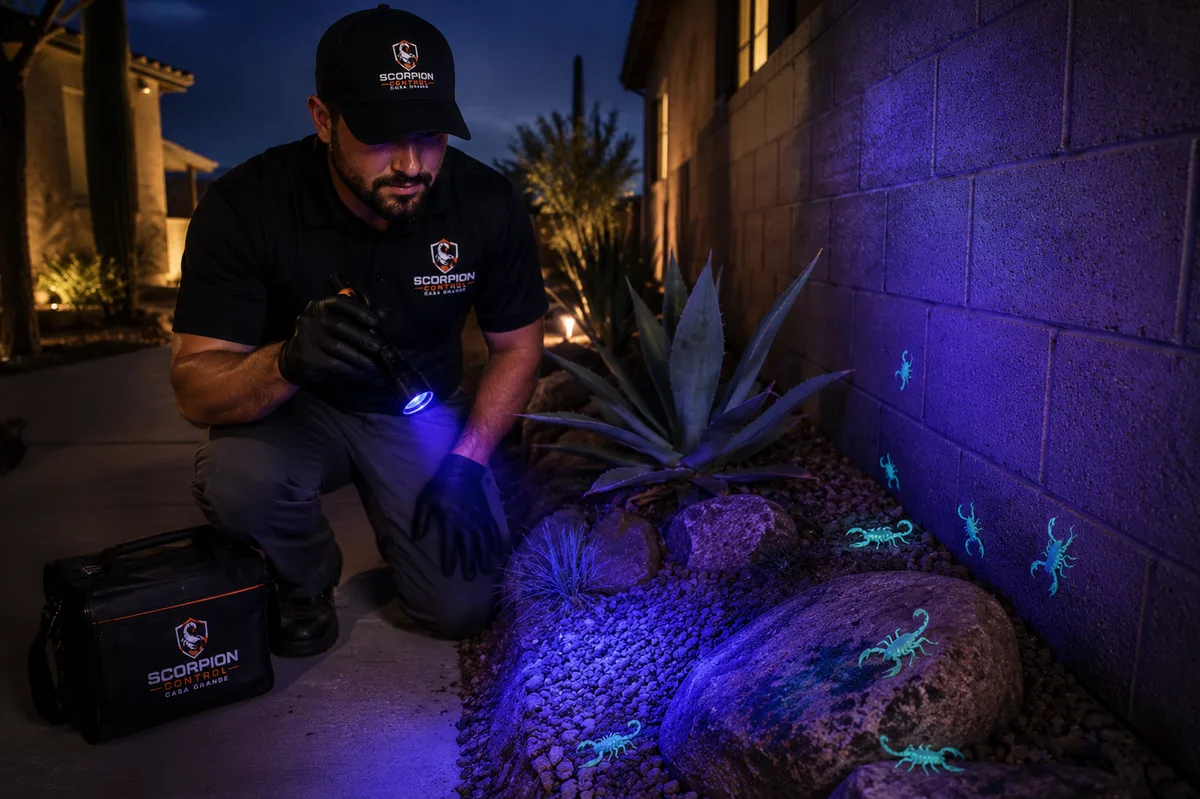
Bark scorpions glow bright blue-green under UV blacklight — that's how we locate them at night. And despite their reputation, cats typically kill scorpions rather than the reverse. The bigger concern is reproduction: bark scorpions bear live young, the mother carries the brood on her back, and litters can be large — so one female inside becomes many.

Single sprays fail against scorpions for two reasons most pest companies won't explain: a scorpion's armored body resists contact insecticide, and it can survive close to a year without eating. So it waits out the treatment in a wall void or under the slab and reappears weeks later.
A bark scorpion's thick outer cuticle is built to hold in moisture in the desert, and that same armor blunts contact insecticides. A spray that knocks down a cricket on contact often won't reliably drop a scorpion the same way. The scorpion generally has to spend time in a treated zone and absorb residual before it's affected — which a quick perimeter spray rarely delivers.
A bark scorpion can survive roughly a year without food or water. They're also communal rather than territorial, so they stack together in harborage like wall voids and block cavities and don't cannibalize each other past infancy. A one-time treatment that misses the harborage doesn't starve them out — they simply sit tight and the population persists.
Because scorpions can outlast a single spray, the lever is denying them the ability to re-establish — not chasing the ones you can see. Sealing their entry points and maintaining a repeated barrier together is what breaks the cycle. And since about 98% of stings happen indoors, exclusion is the part of the job that actually protects the people inside.
"The spray-only callbacks are almost always the same story. The company sprayed, it looked fine for a few weeks, and then the scorpions came right back through the same gaps that were never sealed."— Scorpion Control Casa Grande
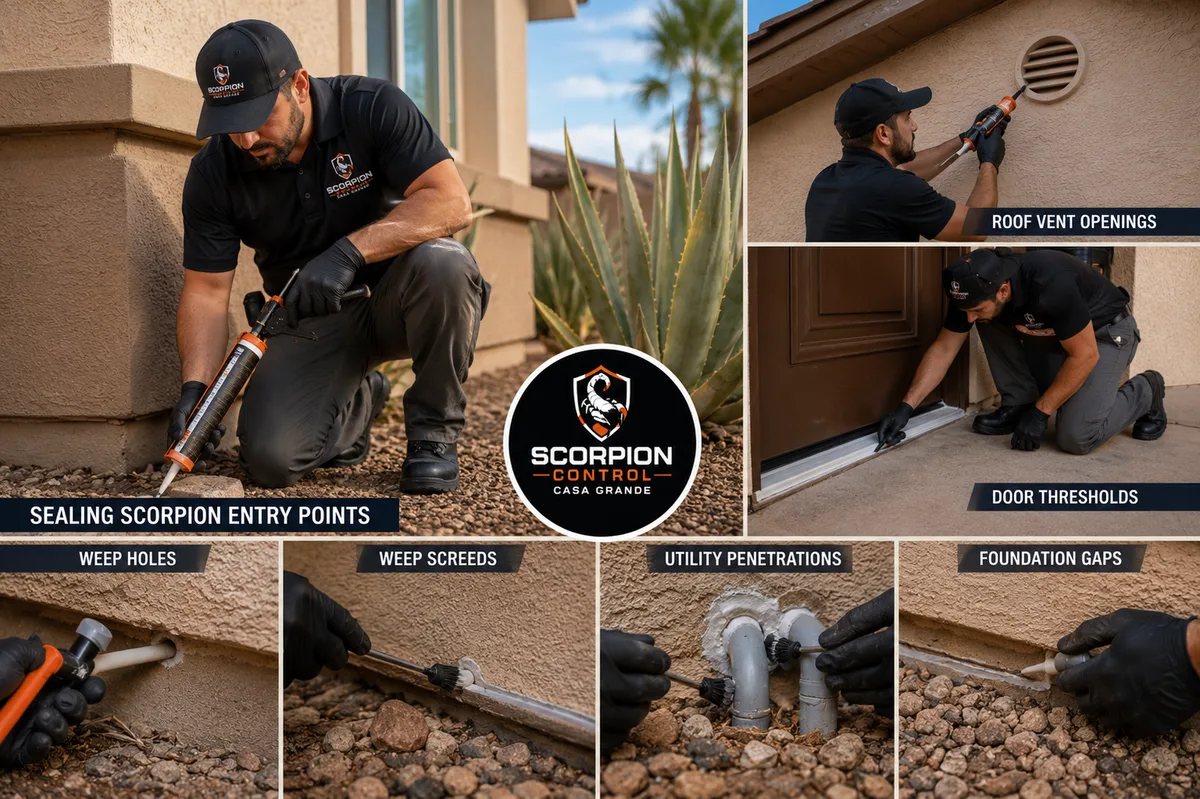
In Casa Grande, scorpions get inside mainly through the gaps built into stucco homes — especially the weep screed (J-trim) where the stucco meets the foundation — plus door gaps, utility penetrations, and roof vents. A bark scorpion only needs a gap the width of a credit card.
The weep screed is the metal trim that runs along the bottom of a stucco wall where it meets the stem wall — it has an intentional gap built in so the wall can breathe and drain. That gap is also a highway. Scorpions, crickets, and roaches ride up behind the stucco and into the wall cavity. Nearly every stucco new-build in Casa Grande has this detail, including homes from D.R. Horton, Richmond American, and Century Communities. The fix is exclusion that seals the entry while preserving airflow — not blind caulk that traps moisture in the wall.
Masonry homes have the same problem in a different form. The weep holes in brick and block veneer exist for drainage and ventilation, and they're more than wide enough for a scorpion to pass through. They get sealed with a method that blocks pests while keeping the drainage path open.
A credit-card clearance under a door is all a bark scorpion needs, and garage thresholds are one of the most common ways they reach the interior. Proper door sweeps on entry doors and the garage-to-house door close that route.
Every pipe, cable, A/C line set, and exterior outlet creates a gap where it passes through the wall. These are sealed with copper mesh packed into the void and a sealant over it, and harborage in the void behind them is treated directly.
Because bark scorpions climb. This is the part of standard scorpion advice that's flat wrong for the species we have here. The Arizona bark scorpion climbs walls and most household surfaces, so it doesn't only enter at ground level. It can scale an exterior wall or reach the roof, get into the attic, and turn up inside through exhaust vents and can-lighting — which is how one ends up on a ceiling or drops into a room. The common "they can't climb, they only get in low" advice leads people to seal the bottom of the house and leave the top wide open. Fine steel mesh over roof and attic vents closes the route the climbing creates.
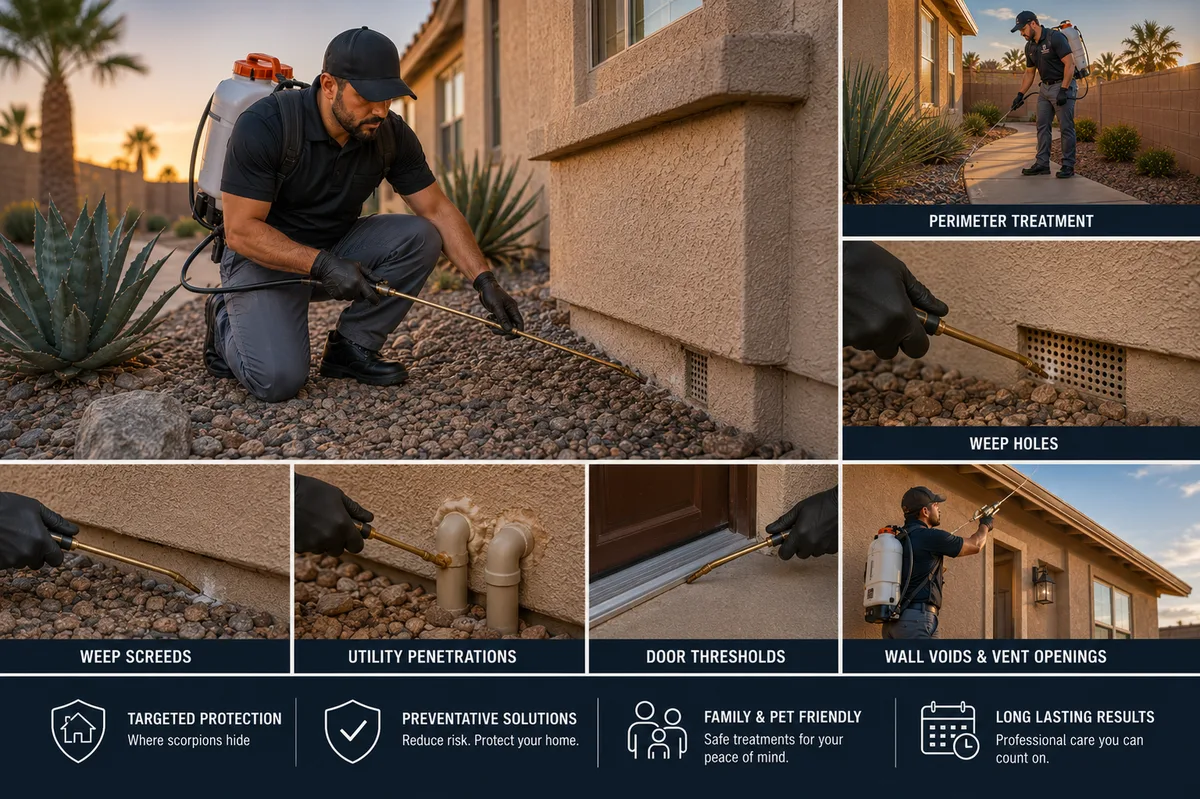
Our approach is built around keeping scorpions out, not just knocking down the ones you can see. Every job starts with finding the specific entry points on your home, sealing them, and then maintaining a treated barrier on a schedule that prevents scorpions from re-establishing.
Including a nighttime blacklight survey. Scorpions fluoresce under UV, so we'd rather see exactly where they're concentrated than guess.
The weep screed, weep holes, door gaps, utility penetrations, and roof vents found during inspection get closed with copper mesh and UV-stable silicone.
A targeted application cuts into the prey source they came indoors to hunt — fewer crickets and roaches means less reason to be there.
A scorpion that can wait a year out will exploit any month the barrier lapses. We keep it active on a recurring schedule so there's never a gap.
If they come back between visits, so do we — at no charge. Scorpion Control Casa Grande is bonded and insured.
"I won't quote a scorpion job before I've walked the house, because the inspection is the work. Anyone can spray a perimeter. Finding the gaps on your specific home is what actually keeps them out."— Scorpion Control Casa Grande
You can meaningfully cut scorpion pressure yourself by removing their shelter and food near the house — though in Casa Grande's bark-scorpion territory, prevention works best paired with sealing and recurring treatment.
The baseline steps all do the same thing: take away harborage and the moisture their prey needs. Clear yard debris and rock piles near the foundation. Keep firewood off the ground and away from exterior walls. Trim vegetation and tree branches so they don't touch the structure and act as a bridge. Repair torn screens, add door sweeps to entry and garage doors, reduce indoor moisture from leaks and condensation, and seal the visible gaps you can reach.
Shake out shoes, gloves, and stored clothing before you put them on — a scorpion will tuck into anything dark.
Scorpion activity around Casa Grande climbs through the warm months and peaks in late summer — roughly August into September — overlapping monsoon season, when humidity drives insect prey up and scorpions follow them toward and into homes.
The driver is moisture. Monsoon rains push insect populations into a boom, the bark scorpion's prey gets abundant, and as the weather turns extreme the scorpions migrate toward the cooler, prey-rich conditions around and inside the house. They're active at night through this whole stretch, which is when stings most often happen indoors.
The practical takeaway is timing. Getting your sealing and treatment in place before peak season — rather than during it — is what keeps the late-summer surge out of the house.
We provide scorpion control across Casa Grande and the surrounding Pinal County communities — including the master-planned neighborhoods where bark scorpion calls are most common.
If you're nearby and don't see your community listed, call or text and we'll confirm coverage.
Check My AddressWe're local, we're licensed, and we seal scorpions out instead of spraying and leaving. Homeowners across Casa Grande and Pinal County choose us because the work is backed and the approach actually addresses why scorpions keep coming back.
Our clients love us — 5.0 Google Rated!
Arizona bonded and insured. BBB Accredited.
If scorpions return between scheduled visits, so do we — no charge.
Before/after and blacklight-survey photos from real Casa Grande homes.
Call, text, or request a free inspection online. We respond immediately.
The Arizona bark scorpion is the only U.S. scorpion with a medically significant sting. It's painful but rarely dangerous to healthy adults. Young children, older adults, and allergic individuals should seek medical care. Call the Poison Help line at 1-800-222-1222 for severe symptoms.
Scorpions have an armored body that resists contact sprays, and they can survive close to a year without food. A single treatment doesn't reach them in wall voids, so they wait it out and return. Sealing entry points plus recurring treatment is what stops the cycle.
Yes. The Arizona bark scorpion is an adept climber and routinely scales walls and most household surfaces — which is why people find them on ceilings or dropping from vents. Ground-level sealing alone isn't enough; the upper entry points matter too.
Most Casa Grande homes are stucco, and scorpions use the weep screed (J-trim) gap where the stucco meets the foundation to enter the wall cavity, along with door gaps, utility penetrations, and roof vents. A gap the width of a credit card is enough.
Yes. Scorpions fluoresce a bright blue-green under UV blacklight, which makes nighttime inspection an effective way to locate them and find where they're concentrated. It's a detection tool, not a control method on its own.
Activity rises through the warm months and peaks in late summer — roughly August into September during monsoon season — when humidity boosts the insect prey scorpions hunt. Getting sealing and treatment in place before peak season gives the best results.
When products are applied according to the label and allowed to dry, treatments are safe for children and pets. Keep people and animals off treated areas until they're fully dry. Our exclusion-first approach also reduces how much product is needed indoors.
In high-activity bark scorpion areas like Casa Grande, recurring treatment works better than one-time service because scorpions can wait out a single application. A regular schedule keeps the barrier active and prevents them from re-establishing near the home.
Ready to stop seeing scorpions? Get a free inspection from a local, licensed team that seals them out and backs the work with a guarantee.